



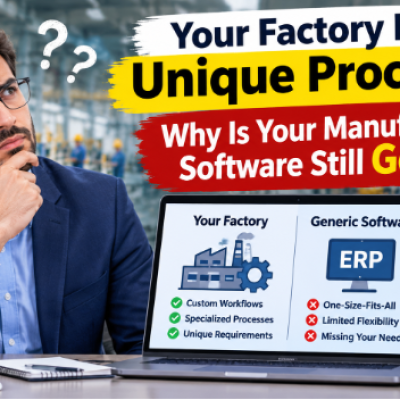

Your production floor runs on years of refined logic — shift sequencing, batch handling, quality gates your team earned through trial and error. Yet the software managing all of it was designed for someone else’s factory. That gap is where custom manufacturing software development becomes a critical conversation. Not because off-the-shelf tools lack features, but because the real damage isn’t in what the software can’t do. It’s in what your teams are quietly doing around it — every single day.
The Workaround Economy Most Manufacturers Don’t Talk About
Walk into most mid-size manufacturing facilities and you’ll find two operating systems running simultaneously. There’s the official one — the ERP or production management platform the company pays for. Then there’s the real one: a network of spreadsheets, informal SOPs, and manual handoffs that have quietly grown around every gap the software couldn’t fill.
This is the workaround economy. It doesn’t appear in your vendor contract. It doesn’t show up in your software audit. But it runs in the background of nearly every shift, absorbing time, compressing margins, and creating process risk that compounds month over month.
The most dangerous misconception manufacturers hold is that workarounds are minor adjustments. In reality, each one is a symptom of a deeper misalignment. That gap doesn’t stay small — it grows because of:
- Every new hire who has to learn an undocumented process alongside the official system
- Every process change that requires manual updating across parallel tools
- Every error that occurs because critical documentation lives only in someone’s memory
What Generic Software Actually Costs You (Beyond the License Fee)
The financial case for staying with generic platforms is usually built around one number: the implementation cost of switching. That framing makes the known cost — a new build — feel larger than the unknown one — ongoing workaround debt. The actual cost looks very different when you examine what generic software forces your teams to absorb silently.
Time Spent Compensating, Not Producing
Production supervisors at facilities running generic ERP systems routinely maintain parallel tracking tools — spreadsheets that capture process nuance the software surfaces poorly or not at all. Every hour spent compensating for software limitations is an hour not spent on output quality, throughput, or team development. That labor cost is real. It simply never appears on an invoice.
The compensation patterns that drain the most time include:
- Manual data reconciliation between the ERP and parallel spreadsheets
- Verbal shift-change briefings that exist solely to cover what the system doesn’t capture
- Supervisor hours spent maintaining shadow tracking tools for floor-level visibility
Institutional Knowledge Trapped in Workarounds
When a workaround solves a problem consistently, it stops being a workaround — it becomes process. Undocumented, person-dependent process. The operator who built the spreadsheet tracking rework loops understands its logic completely. A new hire does not.
The downstream risks compound quickly:
- Onboarding timelines extend because new hires must learn the software and the workarounds layered on top of it
- Error rates during ramp-up increase as informal logic gets misinterpreted or skipped
- When the person who built and maintained the workaround leaves, the knowledge doesn’t transfer — it degrades, breaks, or disappears entirely
Production absorbs the loss quietly because no one ever classified a workaround as a critical system dependency.
Why “We’ll Just Configure It” Is a False Ceiling
Configurability is the most effective selling point generic software vendors have. The promise is straightforward: the platform flexes to fit your needs through module settings, custom fields, and workflow rules. For standard manufacturing processes, this is partially true. The ceiling appears at the exact point where your process stops being standard.
Configurable systems are built to serve the center of the market. Every parameter in a configuration menu was designed with the average operation in mind. When your process diverges from that average, you have reached the ceiling. The scenarios where configuration runs out include:
- Non-linear production sequences that don’t follow a fixed stage-to-stage model
- Conditional quality gates where failure type determines re-entry point, not rejection
- Exception-driven rework logic that the module has no native field to represent
The objection that custom manufacturing software development is too expensive only holds if you calculate the build cost in isolation. Measured against years of accumulated workaround debt — the labor hours, the onboarding drag, the institutional knowledge risk — the arithmetic frequently reverses.
What Software Built Around Your Process Actually Looks Like
From Workaround to Workflow
Generic software asks your team to adapt their process to fit the system’s logic. Purpose-built software inverts that entirely — the actual process becomes the architecture.
Consider a manufacturer running a production sequence with conditional rework loops: units that fail an inline quality gate don’t move to rejection; they re-enter the line at a specific upstream stage based on failure type. No standard ERP module represents that logic natively. A custom build encodes it exactly.
The operational differences that follow are significant:
- Every report is built on accurate production data, not a generic approximation
- Alerts and handoffs reflect actual workflow states, not the closest available module setting
- The system becomes a reliable record of how the operation truly runs — not how the vendor assumed it would
The result is process sovereignty. The software serves the operation, not the other way around.
Why Your Software Partner Needs to Understand Manufacturing, Not Just Code
The failure mode in most custom manufacturing builds isn’t technical — it’s translational. A development team that treats the engagement as a pure engineering problem will produce software that functions correctly but fails operationally.
A capable partner in top-rated custom manufacturing software development begins with process documentation, not system architecture. What that discovery process should include:
- Workflow mapping sessions that capture the actual production sequence, including exceptions
- Documentation of every active workaround and the gap it was built to fill
- Identification of the processes where competitive advantage lives — the ones no configurable module reaches
The discovery phase is where competitive advantage either gets encoded into the software or gets lost in a requirements document no one revisits. Manufacturers carrying years of workaround debt are not operationally behind. A precise build, executed with genuine process understanding, recovers that loss at scale — and removes the invisible tax your teams have been paying on every shift.
Stop Paying the Invisible Tax on Your Own Processes
Every manufacturer running workarounds is funding a system they never chose to build. The spreadsheets, the manual reconciliations, the undocumented SOPs — these aren’t harmless habits. They are a daily operational tax on processes your team spent years refining. The cost doesn’t appear on any invoice, but it shows up in slower onboarding, higher error rates, and institutional knowledge that walks out the door with every departure.
Arobit builds custom manufacturing software that eliminates that tax by encoding your actual process logic into the system architecture from day one. With deep expertise in ERP, CRM, and production workflow development, Arobit works from the floor up — mapping how your operation genuinely runs before a single line of code is written. The result is software that works for your factory, not a factory that works around its software. Reach out to Arobit to explore top-rated custom manufacturing software development tailored to your production floor.
Frequently Asked Questions
- What exactly is a manufacturing software workaround, and why is it harmful?
A workaround is any informal process — a spreadsheet, a manual handoff, a verbal briefing — your team uses to compensate for something the software cannot handle natively. It becomes harmful when it scales: more people depend on it, it goes undocumented, and it begins carrying operational risk the business doesn’t recognize as a system vulnerability.
- How do I calculate the real cost of workarounds in my facility?
Start with three figures: hours spent weekly on manual data reconciliation, average onboarding time compared to industry benchmarks, and the number of SOPs that exist purely to manage software gaps. Multiply each by its labor cost and frequency. Most manufacturers are surprised by how quickly that number exceeds what a custom build would have cost.
- Isn’t configuring our existing ERP enough to eliminate workarounds?
Configuration adjusts behavior within parameters the vendor pre-defined. It cannot reach beyond those parameters. If your most critical production logic — rework sequences, conditional quality gates, exception handling — sits above that ceiling, configuration will not eliminate your workarounds. It will only reduce them marginally.
- How long does it take to transition from a generic platform to custom manufacturing software?
Timeline depends on process complexity and data migration scope, but a phased build approach typically allows manufacturers to run core custom modules within the first quarter while remaining workflows are developed in parallel. A development partner with genuine manufacturing domain knowledge will prioritize the highest-debt workaround areas first, delivering operational relief before the full build is complete.